Emma Jordan
CRITICAL REFLECTION

Using the Body
Reflecting on the processes and themes important to my practice, I have recognized a series of artists that inform, and inspire my work, especially in regards to the methods of mark-making. I have recently learned about the 'Gutai Art Association', originating in Japan in 1954 as the first post-war artistic group. They emphasized moving beyond abstraction into the realm of pure creativity, recognizing the relationship between spirit and matter. In its beginnings Gutai was more focussed on performance based work, exhibiting artists like Kazuo Shiraga, Saburo Murakami, Shozo Shimamoto, and Atsuko Tanaka, each with their own processes and methods to creating work.
Shiraga suspended himself above his canvas, to paint with his feet in his own interpretation of action painting, finding joy and excitement in the creation of his work, layering thick oil paint, sliding his body around to create bold marks. His processes remind me of Carolee Schneeman when creating 'Up to and Including her Limits', in the 1970s, which also has a strong correlation to action painting, suspending herself with a tree surgeons harness, creating linework as a series of performative pieces.
Throwing paint has always been an instinctual property of my practice, and began with the introduction of Jackson Pollock's dripping works. I believe this is why I also find the work of Shōzō Shimamoto so interesting, as he throws the entire bottle of paint to be smashed upon impact, creating a stark explosion on the canvas.
Not only is it the visual language of resulting work, but the physical exertion involved with the creativity these artists employ that I am drawn to. There is a sense of letting the process take over and leaning into unknown forces, but also relying on the body in all four practices. upon reflection, the scale of these works is also impactful, having a larger than human composition, allowing for space and movement as prominent as possible, as well as the method of working from all sides, all of these artists are looking at, and creating their work from multiple angles and perspectives.
Architecture
Artists Rena Papaspryrou and Heidi Bucher both consider destruction and reconstruction of urban and domestic spaces. Papaspyrou employs peeling and deconstructing the faces of existing architecture, bringing it to a curated space to be revived and reexamined in a new context, combining new and old urban characteristics, emphasizing decay. Rather than using the physical building, Bucher creates a new layer a latex skin, that gets peeled off the surface and reconstructed into a replication of the space in the white cube exploring themes of the human existence in space and the strong embodied emotional connections to architectural history. I find Buchers Work 'Small Glass Portal' particularly impactful, and encourages me to consider how I locate my work in a broader context for themes as well as the rubbings.


Kazuo Shiraga working in his Studio, suspended from Scaffolding to paint with his feet
Source: Whitestone Gallery

Carolee Schneeman Performing 'Up to and Including Her Limits'
Source: Carolee Schneeman Foundation

Jackson Pollock dripping paint onto canvas on the floor in his studio
Source: TATE

Shōzō Shimamoto Throwing Glass Paint bottles onto Canvas
Source: TATE
Small Glass Portal (Sanatorium Bellevue Kreuzlingen) 1988. Latex.
Source: The Estate of Heidi Boucher. Photo: Markus Tretter

Untitled (Letter to Husband), 1909, pencil on paper, 6.4 x 4.2 ins., 16.3 x 10.6 cm, Inv. 3621, Source: Prinzhorn Collection Centre of the Psychiatric Hospital of the University of Heidelberg
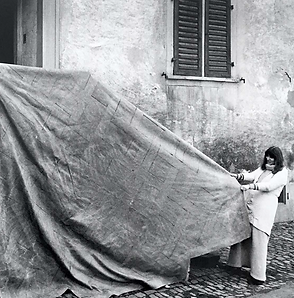
Heidi Bucher with the skinned floor of Ahnenhaus, 1980-1982.
Source; Patterson Zevi
Bucher's work also brings me to think about Emma Hauck, who was admitted to a psychiatric
Rena Papaspyrou at her exhibition 'Images Through Matter' at The Hellenic Centre. 'The Unknown Side' is shown behind.
Credit: Ash Knotek
ARTISTS IN VIEW
Bucher's work also brings me to think about Emma Hauck, who was admitted to a psychiatric unit at the height of her battle with dementia praecox, when her perspective of the world became paranoid of her family. While admitted she wrote love letters (left) to her husband of four years where she repeatedly wrote overtop of her previous line, asking for him to come get her and take her home. Due to the visual qualities of this letter, it has been looked at in an art context. Comparing with Bucher's Latex skin of the Sanatorium, both individuals give insight to the emotional impact of architectural spaces on the human experience, especially those of which carry a psychological and emotionally charged history like hospitals, clinics, and homes. My work is moving towards addressing the broader impact of the emotional and visceral response to architectural landscapes and I feel that the incorporation of places like the Sanatorium in Bucher's work, and the idea of taking physical pieces of a space like Papaspyrou's work is informing me on how to move ahead with empathy, but also the ability to interrogate a space that has caused trauma and pain to our fellow humans. I've begun to explore spaces more intricately through my experience with show installs, working with architectural restrictions, and then by doing rubbings of physical spaces, but feel that both of these artists have inspired me to push that method even further, through scale, material and approach.
Destruction of Material
Throughout the course I have been interested in the decay and destruction of material through methodology. This led me to the practices of Lucio Fontana and Gustav Metzger who both use their artistic processes to manipulate materials in a destructive way. In 1949 Fontana had created a series of works where he punctured and sliced the canvases, symbollicly rejecting the perceived requirements of art creation. He concurrently curated his 'spacial environments' manipulating the experience of a space, taking aim at the technological world, moving away from painting and canvases to create work that coincides with science and physics, coining 'Spatialism'. Both of these series heavily resonate with me, as the repetitive puncturing and cutting is a process that I like to use to expel or reject the overwhelm of emotional processing, and the neon tubing he works with in his spacial environments are reminiscent of guided drawings, creating a simple but captivating form that never ends when following the line with your eyes. Gustav Metzger however, had a different approach to the way he decayed materials, rather than being the direct force and slicing the surface like Fontana, he used the chemical properties of acids to disintegrate Nylon during performance pieces. Metzger invented the term Auto-destructive art, where either through manual manipulation, or natural course of events, an artwork does not exceed the age of 20 years due to its decaying properties and often used this process as a form of protest. In the future I will be incorporating the experimentation of another material decaying the surface, as I find the premise of trauma eating away at someone, a process that can't necessarily be provoked by the constant interaction with the surface, but rather something left to decay by a consuming environment.
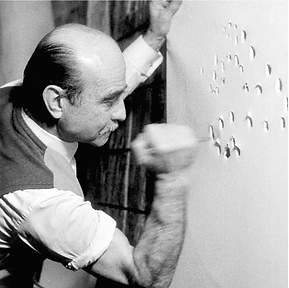
Lucio Fontana
Source: Levy Gorvy Dayan

Gustav Metzger
Source: The Independant

Gustav Metzger Recreation of First Public Demonstration of Auto-Destructive Art. (1960, remade 2004, 2015)
Source: Tate

Gustav Metzger, Auto-Destructive Art Demonstration, South Bank, London, 3 Jul 1961. The Estate of Gustav Metzger and The Gustav Metzger Foundation.
Source: Keystone/Hulton Archive/Getty Images

Spatial Concept 1949–50
Source: Fondazione Lucio Fontana, Milan

Struttura al neon per la IX Triennale di Milano [Neon Structure for the 9th Milan Triennale] Lucio Fontana. 1951. White neon crystal tubes Environmental size.
Source: Fondazione Lucio Fontana, Milano
“Life doesn’t last, art doesn’t last.”
-Eva Hesse
The work of Eva Hesse, specifically 'Expansive Expansion', I found particularly intriguing as its form has shifted presenting a new material quality, fragility, and connections back to the artist.
Hesse had passed away at only 34 years old, and the work she leaves behind continues to age beyond her presence. What was once flexible draping held up by rigid fibreglass poles, now resembles a hide, discoloured and stiff, unable to hang the was it once did. I find this example of material lifespan interesting as it has made me think about the polyethylene in my practice being such a long-lasting substance, and I now question if that is a good thing, or not. The decay is not like the purposeful introduction of an acid like in Metzger's work, but also lives within the question I had asked myself earlier about the possibility of leaving a material to decay in a consuming environment. My polyethylene will long outlive me, no mater how long I live, and although as an artwork I would desire my work to be able to be viewed for many years, it encourages me to think about the broader impact the process of creating and using polyethylene has on the environment. I feel that thinking about alternative materials that coincide with my themes and needs from a surface is something that Eva Hesse work has inspired me to do. I don't know yet if that conversation will end up with me changing materials but the back and forth debate is going to be a necessary decision in the future.

Eva Hesse in front of Expanded Expansion, 1969. Anti-Illusion: Procedures/Materials, 1969, Whitney Museum of American Art, New York.
Source: Frances Mulhall Achilles Library, Whitney Museum of American Art, New York.

Expanded Expansion. Solomon R. Guggenheim Museum, New York.
Source: Midge Wattles and Ariel Ione Williams.

'The Earth is Knot Flat' ( 2 Oct – 15 Dec 2024 ) at Drawing Room, London

'The Earth is Knot Flat' ( 2 Oct – 15 Dec 2024 ) at Drawing Room, London

Accumulation
Emma McNally currently has a show on at the Drawing Room called 'The Earth is Knot Flat' where she is exhibiting large scale drawings and sculptural paper works. I find the sculptural pieces incredibly relevant to my practice theory of compiling experiences and layering, but also the scale of these works are where I'd like to head in the future, employing a strong sense of 3-dimensionality and use of the space.
Throughout the gallery there are piles of mark-making on paper, crumpled, folded, and resting on top of one another, informed by rock formations tumbling into the space. They accumulate and layer themselves to create massive compositions that speak with with one another as you move through the gallery and between forms. The rhythmic and systematic processes imprinted onto and into the paper resonate with me as you can pick out individuals approaches to marks on each crumpled sheet, like scratching, sanding, or repetitive circular motions, and they all connect with one another in a cohesive way. I aim to employ this idea of methods and processes coming together to create a larger composition in my own work, as the scale is something I also want to expand on, much like how McNally has used her materials and gallery space here.
Richard Serra,Verb List,1967
An additional work that I feel I will be referencing and responding to in the near future is Richard Serra’s Verblist, where he orients himself in relation to materials, places, and processes, and is a way to practice in whatever medium he chooses, rooting his work in action painting. As I find process and material so important to my own work, I believe that identifying and accumulating a reference-able language to manipulating and addressing materiality would help me to better understand how I’d like my work to move into more architectural forms, leaning into sculpture and structure compared to the more psychological approach that I've taken recently. I believe this would help me balance out both perspectives to move my. practice forward in regards to composition and process.
Earlier in the year I produced a list of words (right) that begin with “re-“ in response to a side comment from an event about ‘reorienting’ and ‘reframing’, and I feel that it has strong ties to Richard Serra's Verblist and that I can reconsider this list in the way that Serra does by referencing it as part of the process in creating work, not just reflecting as I had been doing in the past.
remove
reuse
reinterpret
reimagine
reconsider
redesign
rearrange
redo
resize
reorient
recover
reclaim
react
remodel
rematch
rephrase
return
repeat
renew
reiterate
replay
rehearse
refashion
regenerate
replicate
reenact
reinvent
reword
retry
recuperate
rethink
relay
reassess
record
recede
recite
replenish
reconcile
retell
reassign
reassemble
reveal
revive
repackage
recount
repay
restore
research
reconfirm
rediscover
recalculate
readjust
reenter
regain
reabsorb
readmit
repurpose
reform
rehash
return
reintend
remark
rehang
redraw
recoil
rectify
reject
reflex
refer
reemit
represent
release
regrow
redefine
recognize
remember
reduce
recycle
reintroduce
retest
redress
regress
rewatch
rest
reface
refilm
refill
retire
retort
rescind
revolt
refeul
refine
reopen
redact
reflect
readapt
rebut
retract
retreat
reshoot
respect
restart
recruit
redraft
revisit
recommit
redirect
reallott
repel
reenact
reconstruct
replace
realign
recall
resettle
reattach
revamp
Argyle, M. (2020) Emma Hauck: Unrequited love letters, RAW VISION. Available at: https://rawvision.com/blogs/articles/articles-unrequited-love-letters?srsltid=AfmBOorP_GL4v0WdIkB_LKLbarbqT1qLX1wshBX7uZ12Qtz0DLUQ0rVn (Accessed: 10 November 2024).
Auto-destructive art (no date) Tate. Available at: https://www.tate.org.uk/art/art-terms/a/auto-destructive-art (Accessed: 11 November 2024).
Biography (no date) Heidi Bucher. Available at: https://heidibucher.com/biography/ (Accessed: 10 November 2024).
Carolee Schneemann. up to and including her limits. 1973–76 | moma (no date) MoMa. Available at: https://www.moma.org/collection/works/156834 (Accessed: 10 November 2024).
Emma McNally London-based artist drawing. In: Emma McNally // Drawing. https://www.emmamcnallydrawing.co.uk/work/emma-mcnally/the-earth-is-knot-flat-solo-show-drawing-room-london-2024. Accessed 12 Nov 2024
(2024) Emma McNally: The earth is knot flat. In: Drawing Room. https://drawingroom.org.uk/exhibition/emma-mcnally-the-earth-is-knot-flat/. Accessed 12 Nov 2024
Gustav Metzger – display at Tate Modern (no date) Tate. Available at: https://www.tate.org.uk/visit/tate-modern/display/artist-and-society/gustav-metzger (Accessed: 11 November 2024).
Heidi Bucher. Metamorphosen (no date) Haus der Kunst. Available at: https://www.hausderkunst.de/en/eintauchen/heidi-bucher (Accessed: 10 November 2024).
Kazuo Shiraga (no date) Axel Vervoordt. Available at: https://www.axel-vervoordt.com/gallery/artists/kazuo-shiraga (Accessed: 10 November 2024).
Kazuo Shiraga (2021) Lévy Gorvy. Available at: https://levygorvy.com/exhibitions/kazuo-shiraga/ (Accessed: 10 November 2024).
Kazuo Shiraga paintings, Bio, ideas (no date) The Art Story. Available at: https://www.theartstory.org/artist/shiraga-kazuo/ (Accessed: 10 November 2024).
Lucio Fontana (no date a) Lévy Gorvy Dayan. Available at: https://www.levygorvydayan.com/artists/lucio-fontana (Accessed: 11 November 2024).
Lucio Fontana (no date) The Guggenheim Museums and Foundation. Available at: https://www.guggenheim.org/artwork/artist/lucio-fontana (Accessed: 11 November 2024).
(No date) Spatialism | artsy. Available at: https://www.artsy.net/gene/spatialism (Accessed: 11 November 2024).
Payne C (2022) The Brooklyn Rail. In: Eva Hesse: Expanded Expansion. https://brooklynrail.org/2022/09/artseen/Eva-Hesse-Expanded-Expansion/. Accessed 12 Nov 2024
Richard Serra. verb list. 1967 | moma. In: MoMa. https://www.moma.org/collection/works/152793. Accessed 12 Nov 2024a
‘Shimamoto Shozo making a painting by hurling glass bottles of paint against a canvas, 2nd gutai art exhibition’, Kiyoji Otsuji, 1956, printed 2012 (no date) Tate. Available at: https://www.tate.org.uk/art/artworks/otsuji-shimamoto-shozo-making-a-painting-by-hurling-glass-bottles-of-paint-against-a-p82286 (Accessed: 10 November 2024).
PROCESS NEAR SELF-DESTRUCTION
Outcomes Beyond Practice
Leading up to term III I discovered how I could push personal emotional limits to explore how close to self-destructive behaviours I could get before recognizing the level of intensity becoming mentally problematic. I observed how purposefully leaning into discomfort was a method that had aided me in addressing unprocessed trauma in an impactful way.
The work I undertook for the summer show played a role in expanding the processes that resonated with me, by challenging methods that activated my central nervous system and built resilience through extended exposure. I became more accustomed to, and accepting of the circumstances of which had a previously negative corresponding reaction.
By working in an environment that slowly increased the visceral sensations over the course of the year, I was able to take note of the strong correlation to the equally slow increase of the ability to withstand those sensations and to not only recognize the resilience change, but to breathe through the once impossible, and proceed with cautious comfort as well. I feel that I had successfully created more room to 'live in' and have altered the imprinted effects of the trauma I had once considered to be rigid and unbreakable.
Reactivity & Resilience
This increase is now reflected in my personal lens on life and I have been able to drastically reduce reactive behaviours and responses to unexpected or decidedly negative circumstances, for example, extreme auditory sensations (emergency vehicles, dropped heavy objects, or slamming doors). Although I have not been working with sound as a factor in my practice, the rise in emotional stability has permeated into an as-needed skill, mirroring how in the "Theory Implemented Practices" model I created in Term II has numerous topics that lean into multiple areas, and affect more than one aspect of the mind/body experience. Although the model was created during term II, I was able to implement it more securely in term III, working across all three categories, and through multiple headings at once.
The reactive behaviours I began the course with were direct results of unprocessed trauma and the immutable perspective that all hardship or discomfort is a consequence of prolonged adverse experiences rather than working on the ability to navigate and grow through disadvantageous events. Van Der Kolk's "The Body Keeps the Score" explores how sensory experiences can become fragmented and take on a life of their own, where the 'essence' of trauma can intrude the present moment and lead to disruptions in perspective like dissociation. As this was an extremely common personal happening prior to working with corresponding methods and
materials in my practice, I knew that if I could raise the benchmark to dissociate, then I would be moving in the right direction. As a result of the slow increase of resilience through my practice, I can recognize the personal criteria for dissociative and escapist thinking has changed and now requires abundant unrest, over the original minor inconveniences. In my perspective, my practice has provided transmission from my brain, through (and including) my body, to materials of choice, leaving a trace of my experience to be perceived during creation but also after the fact.
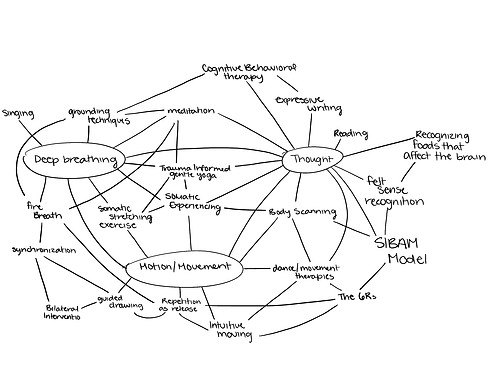
"Theory Implemented Practices Model" - Interpreted interconnections
Click Model to enlarge
ENDURANCE AND CONTINUITY
Time-Based Applications
Endurance had always been a factor in creating work through the methods that I have experimented with during the first two terms of this year, however in term III I have found the need to push beyond the visual elements of mark making and into the exertion of the body through repetition and continuity of process. I had worked on numerous large scale charcoal drawings of which required extensive bilateral movements, muscular exhaustion, and a sense of physical and mental relief upon realization of the drawings, however, most recognizably, the thousands of punctures in "2448" and burn marks in '2511', exhibited the physical persistence of my chosen methods through singularly and obsessively treated surfaces. Although the process had been repeated thousands of times, it took more mental endurance than physical. I focussed on the relationship between the mind while in a creative hyper-focus, the body exhuming emotive and visceral feelings, and the surface of the material experiencing human interventions. Endurance became not just an extension of time-based work, or the amount of force placed upon experimentation and material, but a relationship with the everyday and the studio, the familiar and the unexpected, welcome discomfort and the knowledge of resilience.
Due to the nature of restrictions in exhibition space, I chose the dimensions of these works purely out of the ability to transport them where I need and to take up as much space as I could without impeding on other artists curatorial needs. This has brought up discussions on when to stop, when to call a work finished, and if the process has in-fact been pushed as far as I can push it. Due to this, there is an intense desire to further challenge the endurance and continuity of my polyethylene works, intending to create methods where I can become even more engulfed in the longevity of the practice and engage with what will happen if I keep pushing the endurance, massively extending the time-based application of these methods. I understand that this will throw me back into the first section of this text 'Process near Self-Destruction', but because my practice is rooted in the human response to trauma, a cyclical approach is inevitable.
As a side step to longevity of the work, I have also used the offcuts from the same piece that were not included in the final composition, to create an additional piece. So the materials have extended themselves beyond '2511' and contributed to the continuity in my overall practice. I feel this is also a necessary step when the products that I use in my work are created through oil based processes and I do not want to waste any materials, especially when they are involved with an industry that is harsh to the planet.
It has recently decided that the summer show piece '2511' is not at its final stage as of yet, and will contribute to another extension of this work, lengthening the process again and partaking in further endurance and physically emphasized methods. (see 'Studio Plans' for a proposal of work)

"2448". Spring 2024. 240x345cm. Polyethylene, Steel. Exhibited at Copeland Gallery

"2511". Summer 2024. 300x200cm. Polyethylene, Steel. Exhibited at Camberwell College of Arts.
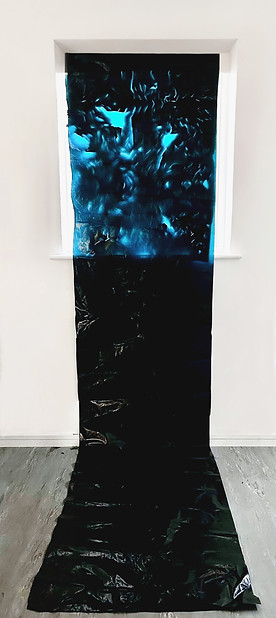
'2637'. 2024. 300x65cm. Polyethylene
PERMEATING SURFACE
Materiality Decision-Making
Paper
Paper had informed my practice through the lens that surface is an important factor when emphasizing the relationship between the human, and trauma. Paper had provided a place for tension, compounding processes, negative space, and navigating boundaries. It was rigid enough to take what I wanted to throw at it but also delicate enough for me to question my methods, emotionally.
I began 'Ripping, Scoring, Cutting' as an approach to my practice with paper as a form of breaking surface, toying with the idea of the underside and the unseen, peeling, pulling, and glueing its face back onto itself, manipulating and disrupting the crisp edge into a conglomerate of its own body and experience until it no longer resembled paper. This is where the notions of decay, and growth stemmed from, and repetition became a compelling characteristic of my practice. I can reflect on how I was subconsciously trying to hide the fact that it was paper, creating a facade of strength by resembling a heavy, sharp, and unbendable sculpture, when the material had been delicate, thin, and good at what it was meant for without the need to be something that it's not.
The more I worked with paper, cutting it, crumpling it, folding it, and covering it, I had become equally desensitized to the process of destroying it, as well as disturbed at how easy it was to destroy it myself. I began to empathize with the paper, and felt a weight in my chest as if it had the capability to feel as I do. I couldn't shake the feeling that I was causing harm, yet I also noticed that once the method had finished, I felt myself in the outcome and could see how I have been able to withstand the very same treatment, purposeful or not. It was empowering but also disheartening to see just how much force was used on this material and it still has a presence, something to admire, and although its shape and face may be different, it was still paper. It was at this point that I began to purposefully correspond the methods of mark-making and permeation of surface to that of the human experience.
I had subconsciously pushed a mortal response onto it by enforcing defensiveness, panic, and fear into the process. I noticed at this point that my methods were starting to resemble the same responses I experienced as a traumatized child, and even though the paper is only paper, an inanimate surface, created for purpose, the child in me relished in being able to manipulate it in ways that I had once desired to manipulate myself out of desire to be seen and loved, or manipulate others out of retaliation. I could relate to a sheet of blankness. I could be the one in control, in power, and at my will the paper would become me too. Two sides of the same coin, yet I am both. I am the manipulator, and the manipulated. I am paper.
Polyethylene
Moving on to the polyethylene material in addition to paper, was a choice that I had made in regards to wanting a surface that could be manipulated in a form different than paper. I was looking for a material that comes from every-day life, made for purpose, and has a permanent quality when pushed to its limits. For example, the original black bin bag tests in term II, I recognized that these bags collect, compile and conceal the bits and pieces humans have accumulated that we don't want to hang on to, or want to dispose of. We ship these bags away to be dealt with among all the remnants of other people who do the same. These products are also rooted in the oil industry, where there is trauma to the planet in its process to both create and destroy. In term III I had to ask myself, 'Why did I want to continue working with this material specifically?' 'What about the qualities found in this material make it intriguing for me to experiment with?' and 'Why black?'
I found the creation of polyethylene an interesting process in addition to the surface malleability and permanence I required of it. This type of plastic comes from the extraction of raw materials consisting of thousands of compounds that are then processed into what is called a 'Monomer', a singular molecule necessary to build a 'Polymer'. Monomers are chemically combined into a chain through a reaction called addition Polymerisation, when you add a substance like peroxide, which in turn most commonly creates polyethylene, polystyrene, and polyvinyl chloride. This bring yet another metaphor to mind where the psychological conjunction of experiences, existing in one lifetime and space, processed into a chain of events, creates one large product at the introduction of a catalyst. All these smaller compounds and materials, combine into a large and hard to digest product.
I was able to also choose the desired weights of polyethylene, where low-density is thin and semi transparent, while high-density is thick, less malleable, and more opaque. I have used both of these in my work, examining silhouette, light play, the variables of barriers both permeable and non-permeable, as well as the notion of hiding and concealing what is behind or beneath the surface. The darkness of the polyethylene was also a conscious choice, where the option to experiment with clear, and coloured bags and sheets was always available. I chose the darkest options as I wanted more manipulation of what is expected beyond the face of my work. If I had used the clear, there would be a more definitive explanation of what is beyond, through, and between the viewer, the work, and the opposing side. I wanted a space to strongly obscure the obvious, however it also had presented a heavy notion of suffocation, suffering, and darkness, which further informs the intensity of the experience of an individual coexisting with trauma, and the necessity of coping.
'2643'. 2024. 60x60cm. Polyethylene on Wood Frame

British Plastics Federation (no date) How is plastic made? A simple step-by-step explanation, British Plastics Federation. Available at: https://www.bpf.co.uk/plastipedia/how-is-plastic-made.aspx#[1%20NEW] (Accessed: 04 November 2024).
IMPLEMENTED THEORY
The 6Rs
This year I have identified how repetition as a process based characteristic had become a source of comfort, reliability, and expectation within methods that address overwhelming feelings of discomfort, instability, and mental challenge. I found after deciding to experiment with repetition, that there is a concept called the '6Rs' that one can implement to create a well-rounded and non-traumatizing approach to developing methods to manage trauma without re-traumatization. 'Dance/Movement Therapy for Trauma Survivors: Theoretical, Clinical, and Cultural Perspectives' categorizes Relevance, Relation, Repetition, Rhythm, Reward, and Respect as the key terms necessary to employ in a well informed practice and to recognize that trauma prevents efficient cortical processing in the brain. Within my practice, I have considered these terms in a wholesome view of my practice and work to include them in a mindful way that works for myself as an individual, as the point of this theory is to tactfully tailor these characteristics to best suit the person who is undergoing therapy. I am self-implementing these and other structures upon myself, so I am able to morph and reevaluate the effectiveness of each key term as I move through my practice.
Repetition in particular has become the most effective of the 6R terms, as I find that it both competes and compliments the obsessive qualities myself and my practice already entail. I have pushed repetition from mark making on a surface, to a practice in and of itself. Looking back on how repetition has come to the forefront of my practice, I notice that not only was it applied as a visual presentation, but a physical and psychological happening. I began with surface treatment of my materials, obsessively throwing and whipping acrylics onto paper, and evolved to the material becoming part of the repetition, not just the place for it to reside, and because of this I found myself taking more time for each process and piece, performing more iterations per piece than when I started, leaning into the discomfort in my body, and restlessness of restricted movements, finding rhythm and momentum.
Dieterich-Hartwell, R., & Melsom, A. M. (2022, March 10). Dance/movement therapy for trauma survivors: Theoretical, clinical, and Cultural Perspectives. Routledge & CRC Press.https://www.routledge.com/DanceMovement-Therapy-for-Trauma-Survivors-Theoretical-Clinical-and-Cultural-Perspectives/Dieterich-Hartwell-Melsom/p/book/9780367629076
Guided Drawings
In addition to the the studio, I've also employed bilateral Movement/guided drawings as written about in 'Trauma and Expressive Arts Therapy: Brain, Body & Imagination in the Healing Process' by Cathy A. Malchiodi. These drawings are done in a therapeutic setting and requires drawing overtop of the original form, 20 or 30 times (at minimum) while in a state of mindfulness and calm. I find this trance-like as the same motions so many times over can distort your sense of time. It is usually meant to be a grounding exercise, however I have also used it to brainstorm and simmer, providing a mental space that I can perpetually encourage new thoughts, as I am always in motion while I draw. This definitely leans back into obsession and process, and I will be continuing to use this method in the future with the intention of expanding how the line drawing itself can be used to reflect, encourage, and resolve feelings of a heightened central nervous system, specifically, 'flight' and 'fawn'. Guided drawings have emphasized the need to experiment with the length and intensity of creating work, recognizing the duration as an important factor to the experience of creation.
during a particularly stressful point in term III where my health had begun to show the effects of stress, I drew the following four guided exercises to calm, ground, and return to a mindful state. They consist of figures I instinctually followed that also included motions from left to right, as well as right to left, to encourage bilateral thinking.

Bilateral Exercise I. 2024. 23x30cm

Bilateral Exercise III. 2024. 23x30cm

Bilateral Exercise II. 2024. 23x30cm
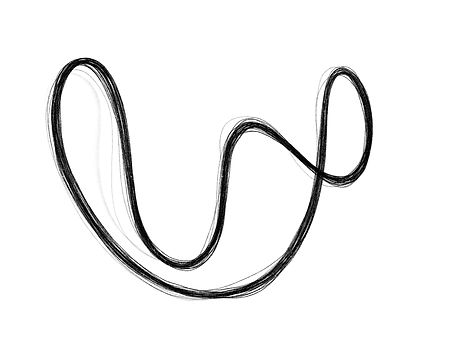
Bilateral Exercise IV. 2024. 23x30cm
Malchiodi, C.A. (2020) Trauma and expressive arts therapy: Brain, body, & imagination in the healing process. New York: The Guilford Press.
SIBAM Model
Referencing "In An Unspoken Voice: How the Body Releases Trauma and Restores Goodness" by Peter A. Levine, I reoriented myself with the SIBAM model again in the context of active creating, rather than reflection of practice, and found that I could notice smaller somatic sensations as I work, instead of waiting until the end and becoming overwhelmed by the amount of stimuli that has occurred during a rather short period of time.
For example, during Term III, I had been packing way experiments done in term II to make room for the creation of '2511'. As I was sifting through a pile of ripped, punctured, and burned polyethylene, I had come across a test piece that I had meant to fold away to purposefully avoid coming into contact. It was a texture created by cutting the surface in groups of lines, a method that I had experienced to be too visceral when creating it, and ultimately decided that it was too overwhelming to challenge at that very moment. Although when I found it again, I thought to examine it, touch it, and really take a deep look at it. I wanted to understand more clearly why I couldn't bring myself to work with this texture in a context that I have complete control over and presents no danger to me. This is where I had to think about SIBAM. SIBAM is an acronym that addresses Sensation, Image, Behaviour, Affect and Meaning, where all categories together give a wholesome look at a person's relationship between the mental and physical. This means that when someone is in a certain mental state, that some connections are very powerful, while others get overlooked and blocked. When stuck in fight or flight and experiencing something like anxiety or flashbacks, you can clearly define the relationship between two sections and the disruptions of all else.
Looking at the test piece in the present I could recognize that I was interpreting holding it in my hands, with strong flashbacks of how it could present danger, not that it is presenting danger now. Thinking of this model I was able to realize that I am missing the connections to sensation, behaviour and meaning, and because of this I was able to ground myself, feeling my body in space, the floor, the air on my skin, and the sounds around me. I was also able to take note of my behaviour, and recognize that I am stuck in fight or flight. Once I became grounded I could think about meaning and note that I was responding to the visceral feeling and not reality. Knowing the different ways these all connect aided me in re-centering myself in the moment.

The Elements of Consciousness in Coherent Experience A graphical representation of Peter Levine's SIBAM model
Source: Albert Wong

The Elements of Consciousness in a Visual flashback
Source: Albert Wong
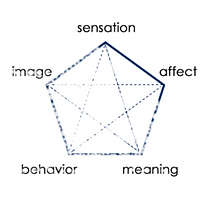
The Elements of Consciousness in a panic attack
Source: Albert Wong
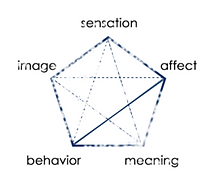
The Elements of Consciousness in
Obsessive Compulsive Disorder
Source: Albert Wong
Levine, P.A. (2012) In an unspoken voice: How the body releases trauma and restores goodness. New York: Random House Publisher Services.
Wong, A. (2020) Why you can’t think your way out of trauma, Psychology Today. Available at: https://www.psychologytoday.com/us/blog/the-body-knows-the-way-home/202005/why-you-cant-think-your-way-out-trauma (Accessed: 04 November 2024).
BODY MARKING
Since my work harnesses a skin-like quality, explores the emotional limits of process, and emphasizes the challenge of addressing trauma, I felt it was necessary to identify how mark-making is significant to the body, specifically the skin. I have presented my work with polyethylene in a way that creates a barrier between both sides of the work, creating an opportunity through intentional ways of seeing (i.e, pinholes) to reveal or conceal the methods of marking. The creation of the marks stemming from emotional and viscerally based methods connects the skin-like surfaces to the idea of harm or self-injury and bodily mutilation/modification. Especially in '2511', the surface was stretched taut, uncorrupted, and was acted on in a way that could be considered violent, permanent and traumatizing. I had to consider the forms of self-mutilation specific to the skin because of my choice of materiality, and how those forms are impactful. I aim to better understand the interpretation of markings in a delicate circumstance, as I've found through conversation that my methods are often seen as injury by viewers, so I feel that investigating the history and reasoning behind marks like these existing is important, even just to understand from a formal and sculptural view of mark-making, that can inform my approach to three-dimensionality and the relationship between form and, space and the viewer, rather than the extensive psychological implications.
My work grapples with discomfort, trauma in its invisible and visible forms, and continually considers how much of my own trauma should be revealed or kept to myself when describing my thought processes and methods. I am asking myself daily if and what I should reveal or conceal about my experiences, both physically and mentally, and can what becomes shown also be simplified to form but remain impactful in more than a psychological regard.
Revealing vs Concealing & Pain vs Tradition
This brings up a conversation about the revealed vs the concealed in regards to the social impact of someone having scars. The Journal of Psychiatric Research reports in issue 130 that around 55% of individuals who have experience with non-suicidal self-injury (NSSI) have scarring from the behaviour, and that there is a more intense negative bias from those who have never experienced NSSI towards those who have, compared to the response to individuals who have non-self-inflicted scarring (i.e, accidental injury) or modification (i.e, tattooing). Individuals who do not have experience with NSSI have also reported that they are less likely to interact socially, romantically, and professionally with those who have visual self-injury scars, further stigmatizing and isolating vulnerable individuals. Some individuals may feel that their scars are socially detrimental or affiliated with negative self-belief, constructing negative emotional responses, while others may bear their scars out in the open as a reminder of their strength to withstand adverse situations. I believe that this dynamic is why some individuals view my work as heavy and loaded, not getting too close, while others find the mark making so interesting and work to understand it further by examining it.
In contrast to the scarring rooted in non-suicidal self-injury (NSSI), there are cultural traditions that involve the manipulation of the skin to recognize belief systems, beauty, and to indicate the stages in person's life. The Pitt River's Museum describes the process of scarification as an invasive and permanent form of marking the body by cutting or branding the skin, and manipulating how the body heals. African and Australian indigenous groups widely practiced scarification with emphasis on creating keloids (raised bumps on the skin) as tattooing was not as effective on darker skin complexions, and keloids produced a more distinct mark. Scarification was often achieved through cutting the skin with a sharp tool to create flat marks, or by filling
a rounded cut produced by a thorn or hook, with clay or ink to produce the bump/keloid. Scarification purposes varies based on the location and group, and most commonly reside on the face, chest, forehead, abdomen, under the breasts, neck, sternum, buttocks, and legs, as group identifiers, or during significant points in the person life. This has been a cultural tradition for thousands of years.

Cultural scarring as body mutilation/modification cannot be differentiated from tattooing, cosmetic surgery, or piercing, and although there are always groups and communities with differing perspectives on what is the 'norm', socially acceptable, or encouraged, scarification seems to have had up until recently, strong systems of individuals who embrace and revere marking the body, compared to the isolating and exclusionary responses to self-mutilation for mental health oriented instigation.
Burke, T.A. et al. (2020) ‘Nonsuicidal self-injury scar concealment from the self and others’, Journal of Psychiatric Research, 130, pp. 313–320. doi:10.1016/j.jpsychires.2020.07.040.
Scarification (2011) web.prm.ox.ac.uk. Available at: https://web.prm.ox.ac.uk/bodyarts/index.php/permanent-body-arts/scarification.html (Accessed: 07 November 2024).
Photographer unknown, courtesy of Allen F. Roberts and the Central Archives of the White Fathers (Missionaries of Our Lady of Africa), Rome.
Sourced: Pitt Rivers Museum
What is self-harm? (2024) Cleveland Clinic. Available at: https://my.clevelandclinic.org/health/diseases/12201-self-harm (Accessed: 06 November 2024).