Emma Jordan
Contextual Reflection
This section will examine texts, exhibitions, and artist practices that have made an impact on my understanding of placing my practice and conducting research.
Each text will pull a from a chapter that has resonated with my practice. All of these texts are widely written and are formatted in chapters of topic, rather than front to back narrative style reading. I have chosen individual sections to include, to be more specific in concepts I think are important instead of an overview of the field.

Dance/Movement Therapy for Trauma Survivors: Theoretical, Clinical and Cultural Perspectives - Edited by Rebekka Dieterich-Hartwell and Anne Margrethe Melsom
In the Chapter "Body, Brain, and Relationship: Dance Movement Therapy and children with Complex Trauma" authors Christina Devereaux and Lauren Harrison identify the effects of Complex Trauma and Adverse Childhood Experience (ACEs), on children in young and critical developmental years, explain Neurobiological Communication and Polyvagal theory, Dance and Movement Therapy (DMT) as a Neural Exercise, and recognize interventions Neuro-sequentially. They do this by introducing theory, and then moving through a case study of an eight year old boy in the USA, "Ricky", who had grown up in a household where he was deprived of the necessary components to emotional growth, experiencing many ACEs, and was unfortunately placed in multiple unsuccessfully matched foster homes, until he finally resided in a residential treatment facility and referred to participate in DMT. This chapter resonated with me because of how the authors explain the approach they use to ensure that the proper avenues are considered when tailoring treatment to a client, no matter their age, however even more importantly with children who are still developing and in turn, act and react to their perspective of the world in ways that further enforce their trauma upon themselves.
The "6Rs"
The "6Rs" are the components necessary to create a well rounded, non-traumatizing, accurate, and helpful plan to integrate into the treatment of the child that recognizes that trauma prevents efficient the use of cortical processing in the brain, and leaves someone working in survival mode. These "Rs" are Relevant, Relational, Repetitive, Rhythmic, Rewarding, and Respectful. Each category must correspond proportionately with the chosen method of theory informed movement.
In an art context, I found this chapter to be incredibly useful in thinking about how I frame my practice through a balance of needs and methods to address those needs. The interesting part is that many of these "Rs" happen to be the same, whereas I practice in a way that I find healing to my trauma wounds from childhood. When it comes to Repetition, Rhythm, Reward and Respect, I unintentionally employed them in term I, and now I can understand why my intuition about these concepts are useful and healing. They are directly rooted in holding space for growth and drawing on processes and methods that I can not only feel good, but do good.

The Body Keeps the Score: Mind, Brain and Body in the Transformation of trauma - Bessel Van Der Kolk
On Page 77, Van Der Kolk describes Dissociation as the "essence of trauma" where an experience can become fragmented to the point where sensory factors take on a life of their own, creating an intrusion on the present moment where a person literally relives the trauma. This presents an obvious complication because the trauma itself has a beginning and end, but for people who experience PTSD like symptoms, like flashbacks, there is no limit to when or where they can arise, forcing another reliving on the trauma, even while asleep. Escapism becomes a prominent theme among people with flashbacks or extreme trauma responses, as individuals will do anything they can to prevent being provoked into the response and run their lives in a way to avoid it at all costs.
Similarly to the previous text, I had accidentally employed escapism into my work in the first term, but have since made the realization that I use escapism in my everyday life as well, and this book has helped me to understand why. It can be exhausting to challenge the physiological response we get from flashbacks or other extreme responses, so avoiding them would seem like a logical way out, however it goes on to explain how we cannot avoid the triggers of day to day life, as they are not proportional to the trauma itself, and sensory overload is the result most times. Like dissociation.
Brain scans performed on individuals coping with dissociation show that very little of the brain is lit up, and that thinking, focus, and orientation abilities are almost completely shut off. Although it may feel impossible to address, it is unavoidable that those who dissociate need to find a way to live in the present and engage with their surroundings to truly manage the brain shut down.
The last line is why I felt it was necessary to including in my practice as through expressive arts, I have been able to feel more present and aware, which can ultimately leads to healing in the brain around past experiences of trauma.

In An Unspoken Voice: How the Body Releases Trauma and Restores Goodness - Peter A. Levine, PhD
Elaborating on the importance of the previous section, Levine heavily emphasizes the benefits of understanding and feeling of bodily sensations. "The Body initiates and the mind follows". this quote was a pivotal point in my own therapy back in Canada, and played a massive role in learning the difference between my body's needs, and my minds conjurings, allowing me to feel first and act second, in my practice as well as outside the studio.
Through this book I have learned what the SIBAM Model is, and how "somatic resonance" and "subtle observation" contribute to strengthening the relationship between the mind and body. As someone who struggles with identifying my senses, and normal operates at a heightening or dissociated stance, I can use this model to try and understand my work post creation, and sometimes what I am experiencing as it happens.
Sensation- Physical sensations that come from the body first. This includes four subsystems. Kinesthesia, where we sense the tension of our muscles, Proprioception, how se sense our joints, and when put together with Kinesthesia, we can identify where we are in space. Next is the Vestibular Subsystem, where we can feel how we are moving through space, by the use of microscopic hairs in the inner ear, and lastly the Visceral Subsystem which includes our blood vessels. Often mentioned in Levine's work is the Vagus nerve, and how it connects our gut to our brain, this would fall under the Visceral category.
Image- this refers to external stimuli, like sight, taste, smell, hearing and touch. visual impression/image is the first form of how we store information from outside our bodies.
Behaviour-this is the only channel that a therapist can observe without having to rely on the experience shared by the client. This category would be split into Gestures, Emotions, and Posture, but also includes autonomic signals from the cardiovascular and respiratory systems, as well as Visceral behaviour that affects gastrointestinal mobility.. Interestingly, a doctor can listen or observe the Visceral Behaviour with an electronic (fetal) stethoscope to the gut when the body is touched in and manipulated. Lastly Archetypal Behaviours, which come from the "deep collective unconscious" where the subtle body movements like hand and arm gestures considered non-voluntary vs voluntary.
Affect- Split into two subtypes Emotions and Contours of feelings. Emotions for example include fear, anger, sadness, joy and disgust. while Contours of feelings or felt sense, are sensation based feelings and not strictly split into the above emotions.
Meaning-This category is quite literal, and encompasses all of the previous subtypes into one space where the we can combine the totality of experiences so that we can communicate with one another. After working through the first 4 channels discussed, we can attach fresh new meanings to our world.

The goal of these drawings is not to identify the drawings, as that would be considered a top-down approach, and when it comes to trauma and the body, A bottom-up approach is more reputable, safe, and effective. The client doing the drawing is encouraged to become aware of the body while doing the drawings, and if appropriate, the therapist may pose questions asking how it feels to direct energy in this manner or encourage the client to recognize how they feel moving, and how it resonates within their body.
Right- examples of the guided drawings referenced in the text.
Trauma and Expressive Arts Therapy: Brain, Body & Imagination in the Healing Process - Cathy A. Malchiodi
This book took me by surprise when it showed what guided drawings looked like in a clinical setting, where a client will create a shape that gets repeated over and over again on top of itself. These variations of shapes are incredibly similar to the forms that I have been intuitionally using since the beginning of term 2. The chapter, much like the above texts, discusses the felt sense and body awareness as an important outcome learned by practicing in this way. This is done as a grounding exercise, which I can understand, as I too find it grounding due to the repetition, It is almost trance-like and can be done while body scanning, or doing breathing exercises. In this book they call it Bilateral Movement/drawing, and emphasized using both sides of the body to process the trauma that is stored within. Using both hands is also a characteristic of my practice and now I can understand why I feel like it is a natural movement. Many people only try to use one side of their body to do certain things, from writing, to sports, to eating, however I've realized that it may be due to not ever trying it, that someone may not know they have the ability to use both sides, and that by introducing a bilateral perspective, we can actually address underlying discomfort in the body that could be from trauma.


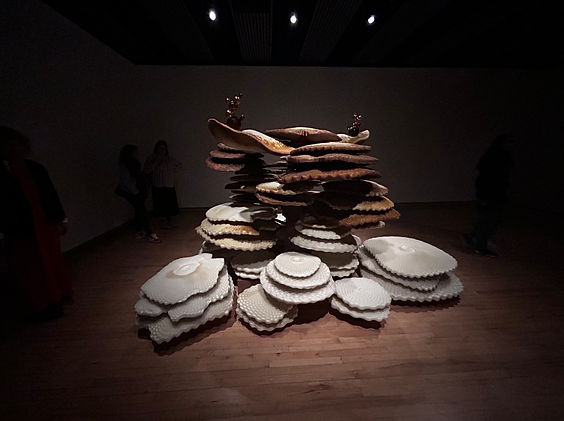

"When Forms Come Alive" at the Hayward Gallery was an exhibition that a group of us went to at the Southbank Centre. I perceived this show as a predominately form based sense of research and focussed on the materiality of the space more so than the context. I realized on the top floor of the exhibition that an Artist I had been researching previously, Lynda Benglis, had multiple sculptures included in the very back of the gallery, one of which I had been hoping to see in person due to its materiality (left). I find her work incredibly interesting because of how it is seen for one interpretation of weight, and surface, while it is actually another. I can empathize with this as I use paper as a medium that I believe can be transformed into its opposing materialistic values. "Quartered Meteor" was created by pouring polyurethane into the corner of her studio in 1969, however was cast into lead in 1975 drastically changing the weight and interpretation of the work.
Lynda Benglis, Quartered Meteor,
Polyurethane 1969, cast in lead 1975
Marguerite Humeau, The Holder of Wasp Venom, 2023, Natural Beeswax, Microcrystalline Wax,, Pigments, 150 year old walmut (cause of death: unknkown), Ahnd Blown Glass, Wasp Venom.120x390x290cm
WHEN FORMS COME ALIVE


Tara Donovan, Untitled (Mylar), 2011/2019,
Tara Donovan, Untitled (Mylar), 2011/2019,
The work I found the most interesting at this show was Tara Donovan's "Untitled (Mylar)" for how it took up space, demanded attention, yet still engaged with the works in the rest of the show. The lighting was also an interesting take as it wasn't fully lit like the rest of the show, but was bright enough through spotlights that the Mylar refracted and reflected throughout the room. It was the only work in this gallery room, and you were able to walk all the way around it which I enjoyed as you could find endless perspectives and lose yourself in the work, forgetting it was in a "white cube" at all. I was feeing quite anxious about creating work that demands space up until this show, now feel like I can understand how to present work in a way that doesn't overtake other work, but still is able to envelope a person into it. Tara has created small fragments of detail, and pull the scale out to the extend where the larger forms can be obvious, however you have to stand and engage wit the work to see the individual loops and curls of the Mylar, theres a sense of fragility but also strength, which is something I would like to come through in my work.

Tara Donovan, Untitled (Mylar), 2011/2019,

Tara Donovan, Untitled (Mylar), 2011/2019,

Tara Donovan, Untitled (Mylar), 2011/2019,