Emma Jordan
Summer Show 2024
Camberwell College of Arts

(Left) "Carbon Study". 2023. 50x70cm. Charcoal on Paper.
(Right) '2511' Summer 2024. 200x300cm. Polyethylene, Steel.
Process and Skill Building
During the planning phase of this work, I decided that using steel instead of the originally planned 2x2s would make the frame of my fairly hidden and more inline with the industrial-leaning materiality I have been experimenting with throughout the year. I wanted a metal frame because of the direction my work is slowly moving into by the inclusion of architectural spaces and forms.
The Metal shop technician, Danny, and I started by discussing the structural and architectural integrity of certain material and design combinations, ensuring that what I wanted to build was possible, as well as able to be removed from the shop upon finishing. Once I was confirmed that my idea would be structurally sound, I learned to weld, use the metal cutting chop saw, the general shop safety, and how to use the protective gear. I also got to observe how Danny ground down the edges of the welds to prevent buckling of the polyethylene sheet I intended to cover it with, and smooth over any sharp edges we may have missed when prepping and cutting the bars to size.
The hardest part of this process was orienting myself to the welding gear without changing how I move and trusting the accuracy of my body. There is a screen inside the helmet that darkens within 1/25000 of a second upon the detection of the light from the welding torch to prevent damage to your eyes, and the shift between states of light instantaneously into a level of dark I've never experienced, I found extremely disorienting. I was not at all used to the transition and struggled to make proper welds in the beginning, but with some practice I managed to keep the materials together and Danny had confirmed that it was a solid connection.
Reflecting on this experience, I can find many psychological metaphors that I relate outside of this shop and what I found resonated the most was the importance of the heavy safety gear necessary to prevent danger when doing an elective process. I had the option to let Danny build it and could've just avoided the process all together under the guise of it being scary or hard, but I was keen on learning to do it myself. I put myself in a controlled but possibly dangerous position to get the outcome I wanted. Taking this process head-on, for me, is very similar to the knee-jerk reaction to wanting to avoiding risk, or a situation that could hurt or go wrong, but when the proper precautions are taken, it can become something that is liberating, empowering, and a contribution to building the. resilience necessary to take back the control that once left us feeling like a victim when we can be the survivor.


Corner weld in the Metal shop

Frame nearly all together, C-clamp to finish last balancing leg


The Welding Helmet
Cutting Metal bars to size
One of the most impactful points my therapist had made to me in my first few years of therapy was "Avoid it, and you make it bigger", and I feel like that is the lesson that I have come back to again and again this year, especially during this process in the metal shop.
Frame nearly all together, C-clamps to finish last balancing leg
Troubleshooting
The Light
Putting this work together with the structure I had built previously became more challenging than I had expected in that once the Polyethylene was positioned in a room that had an abundance of natural light, it was extremely noticeable that the 'black' sheet I had ordered was not at all black. It had let through more light than anticipated, and created a new dynamic that I was not exactly happy with. I think it would make a great work to play around with in the future with but not for this piece in particular. ('2637' on the 'Gallery' page stems from this moment and troubleshooting '2511')
In addition to the sheet not being dark enough for what I had planned, the polyethylene had presented an interesting composition when not tied tightly to the steel. I enjoyed the textures it created through light and crimping of the sheet, and extremely so when we had the window open and it swayed in the breeze. Again, this was not what I wanted for this piece, but it has imprinted a new curiosity in what simple materials can exhibit without such a clean intention, and I plan to use this idea to my advantage in future experiments, draping loose material and working with it in a way *it* wants to work, rather than in a way *I* want it to work.
Using "2448" from the "Where We're Calling From" Exhibition at Copeland Gallery, I combined the works together to ease the issue I had been dealing with due to light, and altered the amount of light that shines through the blue polyethylene, only letting small pinholes create an additional layer of texture. The pinholes were created through an alternative method of repetitive motions and emotionally charged obsession, while the process this piece was prepped to undergo was a similar but almost more violent method of mark-making.
The Layers
The layering of processes, materials, and emotional experience added additional meaning that was more than welcome to the work. I feel that layers as a metaphor and in its physical presence may not always be seen, or considered, but can sometimes 'poke through' and create depth to a situation. I noted that I could more easily recognize the psychological impact of compiling situations. Someone would very easily miss the sections where the bright blue pinholes shine onto the back of the front layer, but those who slow down, or stop and digest the work in its entirety would be rewarded with small moments of intimacy and collaboration between processes.
Reflections
I have two main reflections on my work that I feel I need to interpret and take into consideration moving forward in my practice. Both reflections stem from the same concern in the work, the edges. firstly, I was heavily debating having crisp clean edges to signify that presentation is not the whole story, what is beneath the curated surface may not resemble what one may believe, and the ugly, chaotic, and traumatized history lurks deeper if you dare stop and consider it. The taut, soft surface was also a way to create a skin-like surface, innocent, and pure, having started with nothing interfering or impacting it. Like a child, who will be the unfortunate victim of witnessing trauma scarring their perspectives on the world. in these regards I believe it was successful in its final form. However, secondly I believe there was a strong element to the first that I pinned to the back, '2448' where it hung in a space, creating a barrier, creating intentional ways of seeing through it, below it, or around it, but it also resembled skin in a different manner. It hung heavy like an animal hide, slowly dehydrating, aging, and curing in a butcher's shop. A place where things go to be disassembled, dissected, and deconstructed. A place where the bits and pieces buyers dont want, get separated and removed from its once life-giving, purpose-having intention.

'2511' set-up. Summer 2024. 200x300cm. Polyethylene, Steel.

'2511' Pre-tightening (video) Summer 2024. 200x300cm. Polyethylene, Steel.

'2511' Layering pre-burning (detail) Summer 2024. 200x300cm. Polyethylene, Steel.


'2511' set-up. Summer 2024. 200x300cm. Polyethylene, Steel.
Materials
During a discussion at the Private View I had with my former Professor from Canada, it was brought to my attention how oil-based products seem to be a prominent factor in my overall practice. I had not ever noticed this before which led to a discussion on the emphasis Oil has on the environment. It is a polarizing subject in my home country due to the nature of having entire families, communities and even provinces that are completely reliant on the oil industry for survival, while we also know how heavily negative the environmental impact of the processing and production of oil and its by-products are.
I use these manufactured products in a direct relationship, exposing trauma and the impact on the human, emphasizing decay, experimenting with debilitating limits, speed as a catalyst for creation, with obsession and repetition as a foundation for it all. This all now has an equally important meaning in a different context. We are being acted on in the same way in which I act upon my work. It comes full circle in the sense that I am a human, contributing to a society where oil and carbon currently holds us violently hostage, for me to use the products of those processes to express violent themes of humanness, our fragility and our underlying behaviours, collective and individual, that catalyze trauma and the need for healing.
Final Form and Discussion

"Carbon Study. 2023. 50x70cm. Charcoal on Paper. (left) '2511' Summer 2024. 200x300cm. Polyethylene, Steel. (right)
The Final form of this work involved the process of purposefully gradually deteriorating the surface through mark-making that traumatizes the fragile material. The week of the show I used non-exhibiting hours to spend time burning and melting the polyethylene to create an intricate and dense series of indentations and scarring, ending the week with little area left untouched.The results of this process developed as I had expected, with the welcome addition of the '2448' layer, contributing to the notion of emotionally compiling events and the nature of trauma's effect on humankind.The purpose of this work was to acknowledge and give a visual relationship to the mental and socially invisible circumstances of how seemingly insignificant individual events become a conglomerate that is complicated to digest and manage when it is seen for what it is, rather than all its components separately. How trauma can impact someone not just at times of stress, but by slowly creating a repertoire of heightened central nervous responses and visceral reactions that can suffocate and drown its victim. I wanted the black sheet to resemble many things, an ocean in darkness, waves crashing over head, a body bag, thick and stiff getting zipping up, skin, bearing permanent evidence of pain, right back to the original material, a bin bag, to collect, conceal, and dispose of our unwanted fragments.
No matter what background one comes from, or the path they walk in life, everyone has experienced some sort of trauma, whether they recognize it or not, and because of this vast difference in experience from person to person, this artistic practice would resonate differently, and I hope that it can hold space for the individualized challenges, circumstances, and conditions of life of people who do not share the same experience as I do. Many people had mentioned the finished textures as beautiful or considered, while others found it hard to digest, and read the dark material and violent marks as something bigger than image-making. Everyone is correct in the sense that it is about being human affected by life on earth, working to cope how I feel is best tailored to me.

'2511' Summer 2024. 200x300cm. Polyethylene, Steel. Detail.
Drawing Critique
Yu-chen had made a few great comments in our critique before the show about how work is perceived or intended to be perceived that has resonated with me when thinking back to how my work was interacted with.
"Its not about the art, Its about what the art is doing to people around it."
"Its no longer about the material, but what is done to it...its the holes"
During this discussion we spoke a lot about how we wanted our work to be in the space, not just in a room. How it speaks to viewers and other work. I wanted '2511' to be a part of the space, not just a fixture, so I placed this work into a corner, protruding out and away, with very little room on either side. Viewers had made a point to carefully climb in behind my work, peer through the sides, and shine light onto it, which I had not expected. They had made a point to understand and *see* the work beyond a two dimensional plane. People had interacted with my piece in a way that I hope humans will interact with one another, and I feel that made my work more successful. It makes me believe the work was considered by, held on to, and conversing with the people who were around it. It became part of people while they were interacting with it, and it was seen how a person grappling the same concepts and challenges would benefit from being seen.

'2511' Summer 2024. 200x300cm. Polyethylene, Steel.

'2511' Summer 2024. 200x300cm. Polyethylene, Steel.

'2511' Summer 2024. 200x300cm. Polyethylene, Steel. (Time-Lapse View)
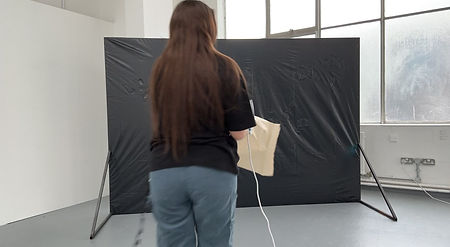
'2511' Summer 2024. 200x300cm. Polyethylene, Steel. (Time-Lapse View)
Artist Talk & Exhibition Tour
Camberwell College of Arts
During the week of the Summer Show 2024, I reconnected with my former Professor Gerard Curtis, from Memorial University in
Newfoundland, Canada, who's just finished leading a group of undergraduate Fine Arts Students through a semester in London studying Art History, emphasizing architecture. I was a participant in this group back in 2017, and it was a major catalyst for my interest in returning to the UK to pursue my Post-Graduate studies.
In June, I assisted these students during a 10-day backpacking research trip from Old Harlow down through Cornwall, to Land's End and back. I offered to have them back to Camberwell to tour the Summer Show, and talk them through my MA experience and art practice. This was the first time I had done an event like this, and found that it was much more natural and exciting than I had anticipated. I normally panic at the idea of non-scripted or curated speaking opportunities, however I greatly enjoyed the feeling I experienced while speaking with them. In turn I felt like I knew myself better then, than I did before the talk.
I spoke about the benefits of working with a diverse cohort from all different life backgrounds, educational experiences, and artistic practices, explaining what I have gained from this year and the development that my practice had undergone thus far. The group asked some in-depth questions about materiality and why I made the decisions I did, the skills I needed to build to execute my vision for my practice, and how to take advantage of the opportunities of an MA course in order to learn what I feel is tailored to my practice. I emphasized that I found trying a multitude of skills early on was extremely helpful to my practice, and refining the methods that I resonated with mid-year had helped me to place my practice in a contemporary context and understand my brain a little better.
I ended the talk with the themes of my practice and how I find that mark-making contributes to the experience of art creation in relation to trauma. They were extremely receptive to digging deeper into the piece and contemplating their own interpretations of how trauma can be not only represented but encapsulated in art, the metaphors *they* see, and what they feel is standing out to them.

Farewell to the Canadian BA students as they return

BA students touring MA Painting
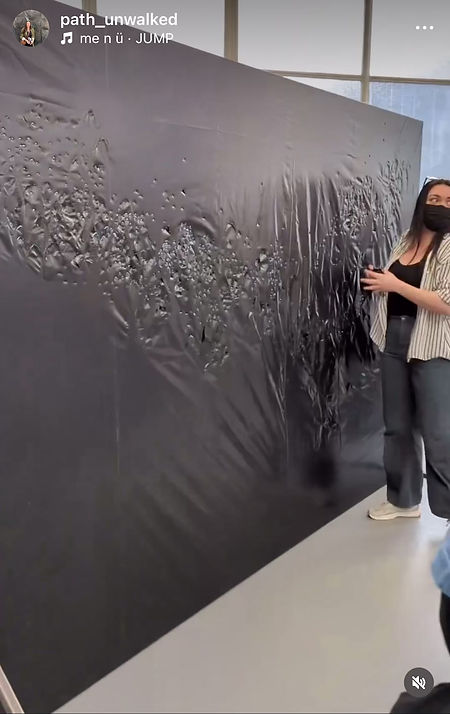
Giving an artist talk in front of '2511'