Emma Jordan
Studio Practices
Scroll down or click the underlined heading to auto-scroll to the corresponding sections.
For explanations and further inquiries into the section content, look for the link under the section headline go to the corresponding "Critical Reflection" page subheading.
Section I: Process near self-Destruction
Section II: Repetition beyond Obsession
Section I: Process near Self-Destruction
In this group of works, I really toyed with how I could affect a surface, without any formal mark-making. I found the plastic to be a great material, as it was malleable enough to manipulate, but strong enough to keep the form, close together, repetitive, and affected. This material was chosen based off an experiment at Millbank, but also the studies done in clay and on paper from first term and early second term.

Detail "2448". 2024
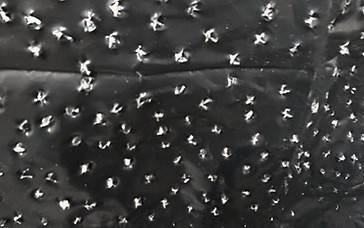
Detail "2448". 2024

"2448". 2024. 230x345cm. Plastic Sheets and Aluminum.


Detail: Texture Study for Term II Work, Material: Clay


Untitled Study for Millbank

Untitled, 2024, 90x60cm Paper

Detail: Texture Study for Copeland Work, Material: Bin Bag
Detail: Texture Study for Copeland Work, Material: Bin Bag
Detail: Texture Study for Copeland Work, Material: Bin Bag
Detail: Black Layered Form, Paper and spraypaint on canvas, 2023
Detail "2448". 2024
Concept of Black and White in my work
I realized half way through this term that I've only been working in black and white, and that I need to address this happening in term II. Black and white is known in many contexts to mean all or nothing. I cannot disagree with this, however when I think about my practice and the fact that mental health is a important part of it, It makes me feel like I need to see the work for what it is. Plastic Consciousness, to me, means that I can recognize that a surface is not wholly one colour, shade, or tone. Light bounces, reflects and refracts off every surface in a different way. What I see at the front of an object in the light, is different than in the shade, even if I painted it all one colour. This means that when I look at my work, I have to see it as a scale, greyscale, but still a scale. Nothing is truly black, or truly white, as space, time, and light play on it whether I like it or not. Grey Matter is the most seen in my work, and Grey Matter is also in the brain. Grey Matter is the tissue that is in your spinal cord and brain that allows for you to function on a daily level. It is necessary, so I find it interesting and necessary in my work as well. It may seem black and white, as many things do, visually, emotionally, socially and politically, but how much of it truly is black and white? Easy to choose a side? or something you can get behind without a perspective balancing in the void between. I believe that nothing truly is black and white, everything comes from somewhere, and whether I agree with it or not doesn't mean that it is a complete yes or no, black or white, valid, or invalid.
Section II: Repetition beyond Obsession
Repetition and Obsession were topics that had been brought up earlier in the year for me, and I'm surprised that I hadn't felt it before someone saw it. I can now recognize that while working with repetition, It feels like an obsession. Moving my body and getting into the rhythm of painting


Untitled Repetitions I, 22x30in, Acrylic on Paper
Untitled Repetitions II, 22x30in, Acrylic on Paper
Untitled Repetitions III, 22x30in, Acrylic on Paper
Large Repetitions I, 4ftx4ft, Acrylic on MDF Board
Large Repetitions II, 150x150cm, Acrylic on Paper
or drawing in this way has taught me that what I have been reading, put into practice, does follow and makes a difference by processing the unknown, downplayed, stored and recessed traumas. Scale in these works is also something I think I'd like to experiment with more in the future as the large pieces were invigorating, whle the smaller ones felt short emotionally.


Sprayed Repetitions I, 22x30in, Acrylic on Paper
Details:Untitled Repetitions I, 22x30in, Acrylic on Paper

The development of landscapes in my forms was a semi-consciousness decision after noting the likeness of mountains and valleys. "Landscape II" (Left) was the first where I had noticed it, thanks to showing it at the "Impromptu" Show at Espacio. An agent had come in asking about about the space, when she mentioned how it made her feel very sad to look at it, and that it reminded her of landscapes she does not get to see anymore.
I was curious how this would work if I purposefully included the concept in my next large scale form drawing, and "Landscape?" (below) was the next opportunity to try it out.
Landscape II, 150x170cm, Conté on Paper

Landscape I, 150x180cm, Conté on Paper

Landscape?, 150x140cm, Conté on Paper

Shower thoughts II, 2024, water on Glass

Shower thoughts I, 2024, water on Glass
The "Shower Thoughts" photographs of water on glass, were a development that I did not see coming at all. I found myself running my finger along the glass door while in the shower, not recognizing that I was making the same forms as in my artistic practice. The obsession had made it out of the studio and into my daily life, and I repeatedly do this now, as if it was always a part of my routine. I will continue to take photos of these remnants of form, and take notes of how they change and shift throughout time.
Section III: Trauma forms and Architecture

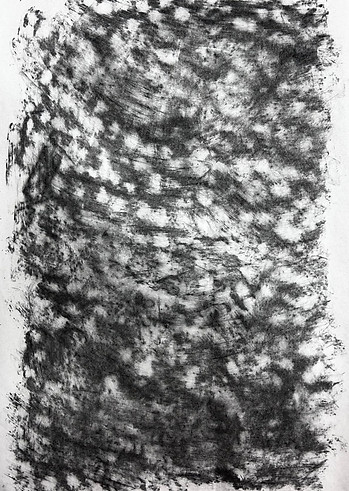
These drawings are rubbings from the floor of the hallways in front of C132. I noticed, as well as had multiple people approach me, about the floor having a familiar texture to the Copeland Piece I was working on, where there had been a blunt trauma to the surface, leaving a trace over and over and over again. Something that had made an impact for years to come, and has dug out a bit of the life of the surface, for vanity? or for resilience? Either way, it has made a permanent mark, a scar, that cannot be filled back in. New material can replace it, but it will never be the same, even when "repaired". I would like to do more rubbings of spaces around campus that have seen time, torture, and trauma, to more closely investigate how architecture has been impacted like humans, or how architecture impacts humans, in the same way.
Floor one, 2024, 35.5x64cm, charcoal on newsprint
Floor two, 2024, 35.5x64cm, charcoal on newsprint

Floor three, 2024, 35.5x64cm, charcoal on newsprint

Floor four, 2024, 35.5x64cm, charcoal on newsprint
Section IV: Speed and Subconscious
This section of drawings ran similarly to the automatic drawings I entered the course with. I did not realize how intuitive fast moving drawings would force me to be, and I highly enjoy creating these, where I felt in a trance-like situation, out of control, but safely tucked into the drawing still. Once again the scale played an important role, allowing for wide body movements, even though the forms are tiny and tight. It was a freeing experience, and I would like to add a more intricate definition of speed to my portfolio of tools, and I'm interested in how speed in conjunction with other processes would result.


Speed and Subconscious, 150x200cm, Conté on Academia Paper


Speed Triptych I, II & III, 2024, 22x30in Conté on Acrylic paper