Emma Jordan
Ripping Scoring Cutting
The following images are derived from studio experimentations intended for larger installation works using the processes of ripping, scoring, and cutting on cartridge paper. These processes were chosen for the purpose of showing light and shadow as forms, opposed to previous drawings with emphasis on tone and line.
To begin the practice of ripping, cutting and scoring, the intention was to peel back layers of a material, paper, to reveal what is within the faces normally seen. Analyzing what sits between the surfaces of what the outside world sees. Looking beyond the carefully dyed, bleached, and curated blankness meant to be a workspace.
Rolling, slicing, and bending the sheet, I wanted to explore how far I could manipulate paper without adding any other material, or adhesive in order to change the shape or strength of the surface. Will it revert to its original flatness with creases or traces of force once used on it? Will it keep its shape as not only a trace but a continuation of its form? The next step in the life of the sheet? Or something that it will try to conceal and revert to its blankness?
Stripping, curling, and prying the paper made it possible to keep the formation of the paper without adding anything else, and proved to be useful in creating texture and pattern. The development of pattern in this process has sparked the topic of repetition, and obsession.


I have identified three preliminary understandings of repetition and obsession, stemming from the visual, physical, and mental relationship to the material.
From the visual punch through the paper having line after line covering the page, to the physical movement of the body having to tighten, force, release, and cater to the paper over and over again. And finally, the mental interpretation of working through the visual and physical, the headspace that has come into play to find ease, passion, and intent on continuation of the process, without building contempt or feeling tedious towards the paper
During these first few explorations and using multiple forms of manipulation, it was decided to focus further on the semi-circular punching motion, and to see what scale could be produced with only one shape repeating.
Could this one motion fill an entire space? How will it hold up structurally? Is the falling apart of the material part of the process? Falling apart, could it be considered decay? Would Decay become an important factor to the process itself? Or at least in the presentation of the work? How would structure and decay, in the presence of repetition and obsession relate to not only the visual, but the physical and the mental load of creating this work?

Continuing on the topic of structure and decay, when the entire form is created by the punching motion, the integrity of the paper becomes far more malleable and fragile. When posted on a vertical surface like a wall or easel, gravity plays a large role in the presentation of the work, changing the light, shape, and interpretive weight of the paper. When faced with the most fragile section upward (Above) the piece curls in on itself, captures the light and reflects it back onto the rest of the page, brightening the composition and relying almost completely on how it is hung onto the wall to stay in one piece without crumbling in on itself. However, When hung with the most fragile section towards the floor (Left) gravity works in its favour, allowing the less structurally sound pieces to hang and cast shadows differently than upright. The light is less forward and casts more predominantly on the points where the paper sits into the space and off the wall. Overall, the surface looks much darker and casts deeper shadows than its opposing orientation.

To remedy and explore the structural integrity of the ripped and punched surface, I let the paper fall over itself and lean into the decay of its once flat and blank face. I did this by adding a very fine steel wire structure just long enough to ensure the paper would not fall off the wall, but also would not change the way in which the paper naturally sits, hangs and pulls. Not only did this prove how the paper was very fragile but also when left to itself could manage to take on more strain than I had originally thought. I very much enjoyed the shadows cast onto the wall and back onto itself with some sections quite illuminated, while others remain completely hidden from studio and stage lighting. This specific piece has encouraged me to take another look at the cut, scored and peel section of explorations done earlier in the term and focus on smaller sections when photographing and playing with light sources. Although I have still come to the conclusion that the semi-circular parts are what I'd like to continue with, playing around with the view of the other pieces has better informed how much light and shadow present themselves in my work, and that I'd like to further deepen my understanding of light with future pieces larger in scale.


A next step in exploration of the surface of paper and the ripping/ punching motion, was to take on the enlargement in scale from one sheet of paper, into layers of the same process in one large composition, I decided to do this by separating two version of the process. One (White Paper Roll) where the layers consist vertically, on one single material entirely, and the second, (Black Layered Form) where the layers protrude from the wall into a 3-dimensional space.
"White Paper Roll" was intended to find out how much shadow and light play could be involved on a single flat surface. Additionally, the paper being on a roll, implies that the there is no sense of "Finished" work, and that the ripped edges are creeping up the sheet, as it unrolls it will continue to become more and more ripped, and decayed. Will it stop? Has it already? Will the entire roll become a pile of ripped, punched, and entangled paper pieces leaving nothing but its cardboard structure on the wall? If this roll were a person, are they healing? Or are they hurting? Is this in or out of control? And finally, with the light peeking through each tiny hole, just large enough for a fingertip, does the light prevail? Is it trapped beneath a textured, abused surface? Will the light bring this piece from darkness into beauty? or does it show something beneath the surface that is meant to stay there?
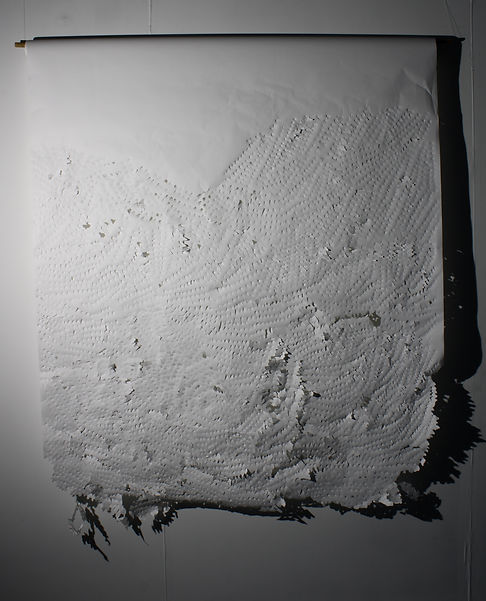

Emma Jordan, White Paper Roll, paper, 5ft continually growing length. 2023
Emma Jordan, White Paper Roll, paper, 5ft continually growing length. 2023


For "Black layered Form" I wanted to try a darker piece, however did not enjoy the quality of paper ripping with actual black paper as it had an altogether different reaction. Instead to trying to manipulate it different than the past pieces, I decided to spray paint it black after all the sections have been glued down onto a malleable backing (unprepared canvas). I did not take into consideration that the paint, although lightly sprayed, would create additional strength to the surface. I didn't notice this because when spraying the work, the paper remained extremely flexible, fragile, and beautifully reflective, however upon drying, the paper had stiffened into the matte, coiled and folded form it was leaning in while being sprayed. I welcomed this additional structure as it allowed me to add far more layers of paper and thicken the composition until there was no visible backing at all. Due to the thickness of the piece, I was able to get many different angles of shadow and light from within it by putting my camera directly into the folds as if it were life-size.
I am still unsure of one aspect of this piece and that is the final shape of the composition. I had intended for it to be a natural form, however it looks too calculated once up on the wall, and especially when in comparison to the white roll displayed next to it. It had an opposing feel, which was amplified more than I had expected, but I feel that the next step for this form of the process will be to find a space for it that it it sits well in, corresponding with the work and feel of the space around it, but also to adjust the framing of the work. It is too tight, and I would like it to be more of a natural feeling upon first inspection of the piece.


Emma Jordan, Black Layered Form, Paper and spraypaint on canvas, 2023