Emma Jordan
Contextual Reflection
The following artists have impacted my practice throughout term 1 because of the processes, materials, theory, and outlook they have towards their own practices.
Kumi Yamashita

Work by Kumi Yamashita I find incredibly interesting because of how intricate the artist is able to portray the figures through 3 dimensional processes in a 2 dimensional presentation. She considers them to be sculptures comprised of both Material, solid object, and immaterial, shadow.
I really enjoy the sense of scale she used, as the individuals depicted are life size, and give a relatable feeling. Anyone with sight has seen their shadow, but its abstracted and manipulated through light and space. These pieces are interesting because instead of the shadow becoming stretched along the ground or bent up a wall, the object casting the shadow is the section most abstracted and the shadow remains to be true to the form as accurately as if it were a real person standing there.

Light & Shadow (no date) Kumi Yamashita. Available at: https://kumiyamashita.com/light-shadow (Accessed: 12 January 2024).
Stace, C. (2023) Silhouettes: Art between light and Shadow, Artland Magazine. Available at: https://magazine.artland.com/silhouettes-art-between-light-shadow/ (Accessed: 12 January 2024).

Cornelia Parker, "Cold Dark Matter: An exploded View", Wood, metal, plastic, ceramic, paper, textile and wire, 1991


Cornelia Parker, "Cold Dark Matter: An exploded View", Wood, metal, plastic, ceramic, paper, textile and wire, 1991 DETAILS
Cornelia Parker
The Installation by Cornelia Parker, "Cold Dark Matter: An Exploded View (1991)" makes me think about how the same materials emotionally influence the space they are in. If this shed was hauled into the gallery space as one piece, containing the items suspended but on its shelving or placed inside it, the space would have an altogether different feel. I think the room would be less emotionally charged, and because explosions are inherently violent, but also paused or frozen in the middle creates a first reaction of unease in the viewer. When will it continue? Is it frozen forever? Am I safe where I am standing? Why is it exploding? Is it getting pulled back together and i'm looking at it backwards?
It is not something you would be able to see in real time if it were to actually explode in this way, so theres a sense of curiosity about it, as something new although also something we as people know happens. Construction and demolition are long standing practices and people actually line up to see buildings get mathematically deconstructed with explosives.
The suspension of the individual objects feels bizarre, and makes me want to walk through the centre of it, and get closer even though it would be something I feel should make someone want to keep a safe distance.
Not only would we not be able to see the physical shed explode in such detail, but the shadows it creates would be gone so quickly, I never even considered how shadows would look in the moment of this motion. There is depth, sharpness and a softness about the edges of the forms on the gallery wall and floor. It brings on a secondary emotional connection for me that settles the unease and presents awe, and a surreal feeling.
Tate (1991) ‘cold dark matter: An exploded view’, Cornelia Parker CBE RA, 1991, Tate. Available at: https://www.tate.org.uk/art/artworks/parker-cold-dark-matter-an-exploded-view-t06949 (Accessed: 12 January 2024)
.

Jackson Pollock painting in his studio on Long Island, New York, 1950.

Jackson Pollock, Number 1A, 1948, oil and enamel on canvas, 1948; in the Museum of Modern Art, New York City. 172.7 × 264.2 cm.
Moma.org | interactives | exhibitions | 1998 | Jackson Pollock | text ... (no date) Museum of Modern Art. Available at: https://www.moma.org/interactives/exhibitions/1998/pollock/website100/txt_possibilities_drip.html (Accessed: 12 November 2023).
Paul, S. (2004) Abstract expressionism: Essay: The Metropolitan Museum of Art: Heilbrunn timeline of art history, The Met’s Heilbrunn Timeline of Art History. Available at: https://www.metmuseum.org/toah/hd/abex/hd_abex.htm (Accessed: 01 January 2024).
Pinnington, M. (no date) Jackson Pollock: Separating man from myth, Tate. Available at: https://www.tate.org.uk/art/artists/jackson-pollock-1785/jackson-pollock-separating-man-myth (Accessed: 01 December 2023).
Tate (no date) Action painters, Tate. Available at: https://www.tate.org.uk/art/art-terms/a/action-painters (Accessed: 3 January 2024).
Jackson Pollock
"When I am in my painting, I'm not aware of what I'm doing. It is only after a sort of "get acquainted" period that I see what I have been about. I have no fears about making changes, destroying the image, etc., because the painting has a life of its own. I try to let it come through. It is only when I lose contact with the painting that the result is a mess. Otherwise there is pure harmony, an easy give and take, and the painting comes out well. ”
-Jackson Pollock
The way in which Jackson Pollock drips and throws his paint across floor laid canvas, unworried about the "wrong" move, was the first introduction I had to abstracted art entirely, and to working in an intuitive, and relaxed, yet energetic and empowering manner. It was the first purposeful inclusion of a process in my own practice, and emphasized the importance of scale, and action. In learning bout Jackson Pollock, "Action Painting" was a term new to me. Coined by Harold Rosenberg in 1952, Rosenberg divulged in ARTnews that "Action Painting" was a process with heavy emphasis on the physical movement of painting, in addition to the importance of the finished product.
Pollock working so directly, from paint still in canisters, stepping on top of his canvas, and physically working from within the confines of the paintings, was what drew me to him and introduced Abstract Expressionism to my practice. Abstract Expressionism emphasizes gesture, impulse, and spontaneity, and in the case of Pollock's Drip paintings, repetition plays a large roll. The repetition of the body moving from canister to throw, flick or splat, and back to canister, or, the circles that have been walked around and around the canvas form a non-consecutive routine, using the same techniques over and over again to layer the paint with a sense of control but also spontaneity.
Just before and into the beginning of term 1, I regularly responded to Pollock's processes by focussing on abstracted acrylic compositions on canvas, then paper, emphasizing working in the moment, intuitively and impulsively. I feel this was an insightful foundation to the inclusion of repetition in my work. Not only did I feel the freedom of working without a prominent figure, but could analyze my own raw emotional connection and reaction to practicing art without reframing my work, and coping through using the body to dispel ingrained traumatic physiological responses.

Jackson Pollock. One: Number 31, 1950. Oil and enamel paint on canvas, 8' 10" × 17' 5 5/8" (269.5 × 530.8 cm).
Cy Twombly

Cy Twombly standing in front of Untitled (Say Goodbye, Catullus, to the Shores of Asia Minor), 1994, oil, acrylic, oil stick, crayon, and graphite on canvas, 3 panels, 157 ½ × 624 inches (400.1 × 1,585 cm), The Menil Collection, Houston
“Each line is now the actual experience with its own innate history. It does not illustrate – it is the sensation of its own realization.”
Cy Twombly
Cy Twombly is an American artist, who spent much of his time and career in Italy, intrigued and often including Greek mythological individuals and poetry in his titles and work. Twombly once said that "the act of painting could come out of ‘one ecstatic impulse".
I find the scale of his work interesting in that I the lines are continual and reach far further than one's arm could manage without moving the body across the canvas as Pollock often did. He was able to create these intense, thick and considered lines and forms by attaching a brush to the end of a stick and working further away from the canvas, accessing the entire piece in more swift motions and all at once.
Cy created an entire language to describe and interpret the gesture in his own mind, balancing between form and calligraphic or graffiti derived lines, or including words from poetry or mythological narratives.
I enjoy the scale at which Cy Twombly works, and the innovative thinking of how to get the line quality and mark-making he wants by using tools that provide the body the modifications needed.

Untitled (Say Goodbye, Catullus, to the Shores of Asia Minor), 1994, oil, acrylic, oil stick, crayon, and graphite on canvas, 3 panels, 157 ½ × 624 inches (400.1 × 1,585 cm), The Menil Collection, Houston


Cy Twombly, Bacchus, Acrylic on canvas, 327x 412.5cm, 2006-8
Cy Twombly, Sunset, 1957
Cy Twombly (2018) Gagosian. Available at: https://gagosian.com/artists/cy-twombly/ (Accessed: 17 October 2023).
Cy Twombly, Grosvenor Hill, London, October 10–December 12, 2015 (2018) Gagosian. Available at: https://gagosian.com/exhibitions/2015/cy-twombly/ (Accessed: 13 October 2023).
Tate (no date b) Cy twombly – display at Tate Modern, Tate. Available at: https://www.tate.org.uk/visit/tate-modern/display/in-the-studio/cy-twombly (Accessed: 01 January 2024).
"I need to make things. The physical interaction with the medium has a curative effect. I need the physical acting out. I need to have these objects exist in relation to my body."
Louise Bourgeois
“I like to be a glasshouse. There is no mask in my work.”
Louise Bourgeois
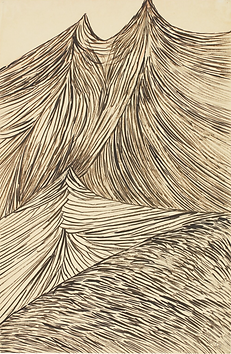
Louise Bourgeois is a french American contemporary artist most well known for her sculpture and installation work, but also drawings, prints and paintings. Her work often centres the body, sexuality, family, trauma, and death, of which derive from her personal life and experiences as a child. Though interested by her massive 9-metre spider sculptures and caged in "rooms", her drawings struck a cord within my practice, with repetition, and the subconscious as a heavy influence on the work. Between November 1994 and June 1995 Bourgeois a group of 220 drawings, poems and sketches, of which she title "Insomnia Drawings", since she had wrestled with sleeplessness very frequently. These drawings depict abstracted shapes, geometric forms and wavy, scalloped or spiralling lines. She keeps paper near her bed to be able to draw night and day when she feels compelled to.
I find the insomnia portion of the series is extremely interesting, and I empathize with the circumstances where she creates under, where she is using an experience that she does not necessarily have control over to her betterment, and taking advantage of the situation to bring forward parts of her experiences through art.
Louise Bourgeois


“‘I Don’t Need an Interview to Clarify My Thoughts’: An Interview with Louise Bourgeois.” Artspace, The Phaidon Folio, August 22, 2017. http://www.artspace.com/magazine/interviews_features/louise-bourgeois-phaidon-folio.
Louise bourgeois | moma (no date) Museum of Modern Art. Available at: https://www.moma.org/artists/710 (Accessed: 01 January 2024).
Insomnia drawings (2023) Insomnia Drawings. Available at: https://www.fondationbeyeler.ch/en/exhibitions/past-exhibitions/insomnia-drawings (Accessed: 01 January 2024).
Random International
Random International is a post digital art group most well known for very large scale interactive installation work that include a variety of mediums, for example sculpture, light, video, print, sound, and kinetics. The aim of which the group intends is to question "What it is to be alive today", interested in interconnections from self to others and world, and the differences we experience between people.
The emphasis on interconnections and recognizing differences from one another's perspectives, coupled with the scale and interactivity of the work is what has caught my attention. Specifically, "Rain Room" and "Living Room" come to mind when thinking about how I would like to scale up my own practice to where the viewer of the work becomes engulfed by the space entirely. In "Rain Room" the audience can walk through a space simulating actual rain, without getting wet or touching the water at all, yet still experiencing what it is like to be completely immersed in rain. It is an interesting idea to me, to have someone juxtaposed into a place where they can experience what someone else would be, with or without the "consequences" of if they were in that circumstance in a non-simulated environment.
It bring up the question of is it the same experience? Is this a process to show empathy for experiences an individual may not have experienced? Can humans come together after experiencing a curated space meant to portray a particular emotion or response? Response to what? Does it leave an impact once leaving the exhibit?


RAIN ROOM, 2012, water, injection moulded tiles, solenoid valves, pressure regulators, custom software, 3D tracking cameras, steel beams, water management system, grated floor from 100 sq m

RAIN ROOM, 2012, water, injection moulded tiles, solenoid valves, pressure regulators, custom software, 3D tracking cameras, steel beams, water management system, grated floor from 100 sq m
Biography (no date) Random International. Available at: https://www.random-international.com/biography (Accessed: 01 January 2024).
(No date) Random International. Available at: https://www.random-international.com/rain-room-2012 (Accessed: 01 January 2024).
LIVING ROOM, 2022
custom light modules, custom electronics, custom software, lidar sensors, fog machines, data and power control unit, From 100 sqm
Karla Black

Karla Black, Doesn’t Care In Words 2011 (detail), Cellophane, paint, Sellotape, sugar paper, chalk, powder paint, plaster powder, wood, polystyrene, polythene, thread, bath bombs, petroleum jelly, moisturising cream, Dimensions Variable.

Karla Black, Presumption Prevails, 2017, Venice Biennale, The Arsenal, Venice

Karla Black exhibition View at Modern Art, London 2022. Photography by Tom Carter
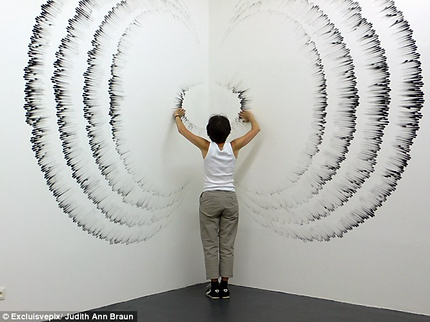
Judith Braun is an American Artist born in New York City. Her work varies from Lifelike paintings of angels in the 80's, to massive photocopies of genitalia in the 90's and charcoal drawings and fingerprint murals ranging from miniatures to wall murals. From the start her name in the art community has changed multiple times seeking a sense of self, including Weinman, her once married name, then converted to Weinperson, and back to her birth name of Braun. This journey is described by herself, best represented in her work "Homeostasis" and "Crazy Bitch" from 2016. Since then Judith's work has centred symmetry, and carbon materials.
On her CV website, Judith Braun includes this interesting perspective: "Working within a framework reflects my philosophy of freedom through discipline, serving as both a trigger and a filter."
I enjoy that Judith is using her practice as a form of self realization and discovery in addition to unravelling her childhood and trauma from her years witnessing communes turn into cults and domestic violence in the 60's.
Karla Black is a Scottish abstract sculptor who focusses on understanding the world around her through material exploration.
She mainly uses material such as plaster, paper, paint and chalk in her installations, of which she describes as "almost" or "only just" objects, often balancing form and scale. "Almost installation", "Almost performance art".
Her work is informed by psychoanalytical theory and specifically the works of Melanie Klein (who's research lead to the development of "Play Therapy") and the observation of children through the lens of the field.
The gesture is an important aspect to Black, manipulating forms by crumpling, draping, crushing, twisting and stacking with intent to create sensory emphasized environments, and each piece is considered within the gallery space encouraging new ways to look at the space.
Quotes I feel are important:
"I tend to think of the materials as something that I can’t help but use, something that comes out of desire, out of the unconscious."
Karla Black (quoted in Black, p.178).
"The mark, if proof of anything, is proof of the joy of a raw, loose, creative moment. It is the by-product of sensation felt."
Karla Black (quoted in Black, p.176)
‘The meaning is in the physical reality of the sculpture, what can be drawn from it is drawn from the material experience of the person looking at it.’
Karla Black (quoted in Figner and Shwabsky, p.13)
Klein’s life: A timeline (no date) Melanie Klein Trust. Available at: https://melanie-klein-trust.org.uk/timeline/ (Accessed: 01 January 2024).
Susanne Figner and Barry Shwabsky, Karla Black in conversation with Barry Shwabsky, in Karla Black, Walther Konig, Koln, 2014.
Karla Black, Its Proof That Counts, exhibition catalogue for Inverleith House, Royal Botanic Gardens, Edinburgh, November 14, 2009-February 14, 2010.
Karla Black (no date) National Galleries of Scotland. Available at: https://www.nationalgalleries.org/art-and-artists/features/karla-black (Accessed: 01 January 2024).
Judith Braun

Fingering #10 Parallel Art Space, Brooklyn NY, Charcoal Fingerprints on two walls- 10 X 12FT - 2012
(No date a) Judith Braun. Available at: https://judithannbraun.com/about/bio (Accessed: 01 January
2024)
(No date a) Judith Braun. Available at: https://judithannbraun.com/fingerprint/fingerprint-walls (Accessed: 14 January 2024)..
Fingering #5 Duve Berlin - Berlin, DE - CharcoaL Fingerprints on two walls- 8 X 8 FT EA - 2010
Martin Creed


Martin Creed is a British artist, performer, composer. He won the Turner Prize in 2001 after exhibiting a single installation, "Work No 227: The lights going on and off" (below right) where an empty room is lit with gallery lighting for five seconds, then reduced to darkness for the following five seconds on repeat. this piece challenges typical museum and gallery display conventions, forcing the viewers to engage with the actual space itself.
Martin also has categorical style of naming his works by simply titling "Work" followed by a number and short explanation of the piece.
He reintroduces the viewers to common objects or elements like paper, Blu-tac, tape, balloons, and language as a reminder and celebration of the "ambiguity of everyday stuff".
In his series of installations called "Half the air in a given space", he measured the the size of the room, and filled it with blow up party balloons until half the space was occupied by ballon itself, leaving only a small area to be able to view, move around, connect with one another. To some this would be perceived as a joyous experience, with playful and childlike elements. I wonder what would happen if someone who was claustrophobic in tight or small spaces, or generally resistant to isolating experiences would interpret the balloons in comparison to someone who enjoys them.
Questions/Ideas prompted by this work:
Would the undertones of this experience become reversed and anxiety filled, or a triggering afternoon for some? This installation has encouraged me to consider the multitude of sensory, and experiential elements of my future work, while accumulating information on upscaling the interactivity and immersive qualities of my own work. Will it provide the experience I intend? Or will the work rely on viewers backgrounds to be similar to my own? How can I create empathy and understanding between viewer and artist, when the interpretation of the wok can be so various and dependent on the experiences we bring with us everyday?

Martin Creed, Half the air in a given space, air filled party balloons,1998. 4 Locations


Martin Creed, The lights going on and off, 2001, Gallery Lighting
Tate (2013). ‘Work No. 227: The lights going on and off’, Martin Creed, 2000 | Tate. [online] Tate. Available at: https://www.tate.org.uk/art/artworks/creed-work-no-227-the-lights-going-on-and-off-t13868.
Tate (n.d.). Martin Creed born 1968. [online] Tate. Available at: https://www.tate.org.uk/art/artists/martin-creed-2760 [Accessed 13 Nov. 2023].
Inter-lab (2014). Half the air in a given space by Martin Creed. [online] inter-lab. Available at: https://interlabresearch.wordpress.com/2014/04/05/martin-creed-half-the-air-in-a-given-space/ [Accessed 13 Jan. 2023].