Emma Jordan
2-Dimensional Studies
The following images are of preliminary compositions from term 1 in the decision process for what types of mark making I want to continue with, and questioning material properties of acrylic paint, and carbon materials. Each composition will have a text in correspondence describing why it was created in the manner it was, as well as what I learned after its creation.
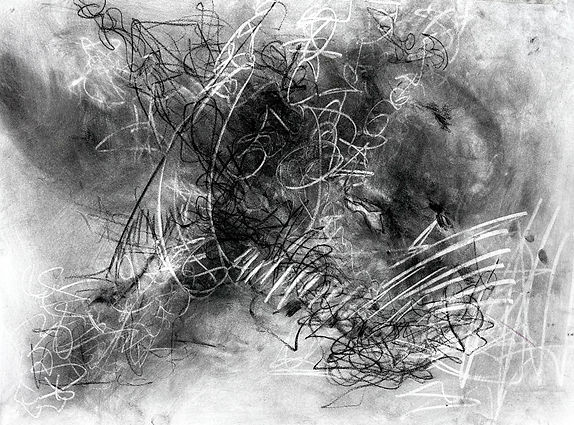
Charcoal, Graphite on paper, 22x30
The Study to the left, was one of the very first compositions in my Camberwell career. Completed in the first 2 weeks in the studio, I was working in the way I found most comfortable, using carbon based materials, and erasing as a form of marking. When deciding how to move forward I knew it needed to be an abstract process, where impulsive action would be welcomed and beneficial instead of hinder the work and its progression over time. I recognized in this study that working with black and white emphasizes light and shadow, and that shadow was something i'd like to explore further.
The study to the right was produced during a workshop exploring light and sound in correspondence with lenses, and projectable objects with Helen Maurer. I highly enjoyed the workshop and when we started with drawing to sound I knew that this would be an interesting afternoon for me. This study was comprised of three soundtracks where the environment would shift with each song. Instead of working on three separate sheets, I decided to work on one in layers. I had never actually thought about my own work in layers, and I often work to multiple soundtracks in studio. This exercise drove home how I could amalgamate my layers to correspond with each other, but also that it wasn't necessary to do that either. Each layer I completely ignored the one underneath and waited until the end of the session to decided whether or not I enjoyed the way it turned out or if I wanted to edit and manipulate it afterwards. I chose not to, and that It was finished long before I looked at the final product.

Charcoal, Graphite on paper, 18x24

Acrylic on paper, 18x24
This acrylic work was practice in fine motor and repetitive motions. The entire composition was created by fingertips and all of the mixing of black and white were done on the paper itself. I found this to be a liberating process where I didn't have the worry about the final product at all, even though I normally try to have the attitude that process is equally as important as the product in the end, it was much easier with no tools, or preplanned idea in my head. I used this composition to inform the next duo of acrylic based works.

Acrylic on paper, 18x24
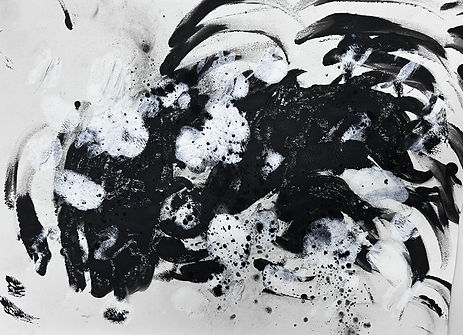
Acrylic on paper, 18x24
The 2 compositions above were produced at once. I wanted to emphasize impulsivity and obsession with this duo and decided that I would work quickly, and without prior planning, to see where the composition went if there was no point in the creation where 'no' was a thought. Interestingly, although I have worked in this manner prior to this duo, I have never worked on two pieces at once where I used both of them as materials and processes on the other. I started on one piece in acrylic and had faced the opposing sheet face down to print the tones from one onto the other and visa versa throughout the session, peeling them apart to reveal itself kind of like an ink blot test. Flipping back and forth from one to the other being dominant in creation, the impressions and prints left on the opposite sheet change intensity with each addition. I'd consider them a mirror image of each other even though there are some distinct differences. I would like to increase the scale and repeat the process on canvas to see what kinds of marks can be made when the acrylics and powders are thrown and whipped verses using the fingers.

The purpose of this study was to consider 2 dimension material, combined with the same processes I have been using, for example using fingertips and acrylic paint to drag and mix paint across a page. It was also a challenge to myself to consider the layering of my work, which I do not find was successful. I do enjoy the parts where the powder was laid upon the top layer, made of tracing paper, and the tone can be seen through to the paper layer, however don't feel that it was a strong enough characteristic to make the study overall successful. the separation of the darkest black acrylic 'blob' to the right makes it feel slightly more observational, as if under the sea near a reef, but again, not the interpretation I am going for.
Acrylic, Charcoal, on Academia and tracing paper, 22x34

Graphite on paper, 18x24


The composition to the right stems from the same acrylic fingerprint piece that the duo above did. However this piece was done purely in carbon based powders and all markings were from the oils of the fingertip peeling away the layer of powder resting on the page. The last markings on the page were circlings of individual fingerprints done in compressed charcoal. I did this piece to see if I had any preference of material using
the same process, and to see if the fingerprints would have presented themselves more clearly in the powder, of which they did. Upon close inspection the fingerprints that reside in sections where the white paper shows through, the lines of the print are easily viewable, strongly characterizing them as fingerprints and not a manmade tool. I enjoy that this piece is slightly calmer than the acrylic counterpart, however also feel that it is flatter and more dull. If I were to create another edition in powders I would use a darker charcoal, instead of graphite to create more depth of field and contrast in the composition.
The acrylic piece to the right was an exercise in simplicity. A challenge to myself where I normally find it very easy to fill a composition with plenty of textures, or markings. This piece was done in one dip of the brush and I finished when it was becoming too dry to continue without dipping it again. I believe this challenge was helpful in realizing I do not need to worry about filling a space, as the negative space in a piece is still space, and provides a service to the work in and of itself. This composition ended up informing the 'white paper roll' piece mentioned in the 'Ripping Scoring Cutting' section.

Charcoal, Graphite on paper, 18x24

Acrylic on paper, 22x30
One of the first drawings on the course, was a test of tape resist and charcoal. I had done resists in dyeing previously, and had used tape in painting, but noticed I had never done it with charcoal, so this piece was an exercise in layering across the entire page and using powders in a sense that allowed for the layers beneath to still reveal themselves enough to see the harsh lines and change in textures. I feel although this was too observational for where I want to go, but that it was successful in the use of layers, and further informs future works that use layering whether 2 or 3 dimensional.
The final composition in this section was a test in speed, and contrast. The intent here was to complete the piece with portions of the composition done at different speeds, so that I could analyze how the line quality changes and to find out just how much contrast is still able to be a strong characteristic, no matter what speed you are working at. For this piece, I started out with slower and more controlled movements and fingerprints, to high speed graphite and charcoal lines cornering the page. There is still quite a lot of contrast, so I feel that was successful, and I think I could also push the different speeds a little further while better considering the line quality, and moving from the same thickness and shape to a more rounded set of lines. I will likely do another challenge like this in the future as an exercise.

Charcoal, Graphite on paper, 18x24